
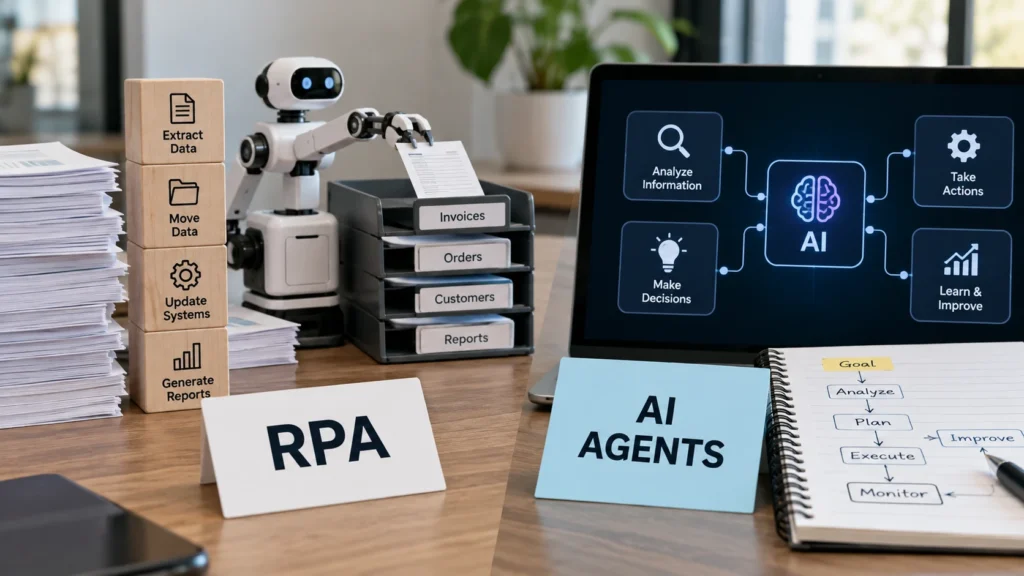
The RPA vs AI agents debate is usually framed as old technology against new. That framing leads companies to buy agents for jobs a simple bot would do better, or to force bots onto work that keeps breaking them. The better question is what kind of task you are automating.
The short answer: use RPA for repetitive, rule-based work with structured inputs that rarely change. Use AI agents where the work requires reading, judgment or handling variation. For most companies, the first automation should be the highest-volume task with clear rules, and agents come in where those rules run out. That sequencing is the core of how we approach process automation.
What RPA and AI Agents Actually Do
Robotic process automation (RPA) follows a script: click here, copy this field, paste it there. AI agents use a language model to interpret inputs and decide the next step within limits you set.
| RPA | AI agents | |
|---|---|---|
| How it works | Follows fixed rules step by step | Interprets inputs and chooses actions within set limits |
| Best inputs | Structured: forms, fixed screens, spreadsheets | Unstructured: emails, PDFs, free text |
| Handles variation | Poorly; a changed screen can break it | Well, within the scope it was given |
| Predictability | Same input, same output | Needs checks and human review on key steps |
| Typical first use | Data entry between systems | Reading and routing requests |
When RPA Is the Right First Step
- The rules fit on one page. If a new employee could follow written steps without asking questions, a bot can too.
- Inputs arrive in a fixed format. Exports, web forms and system screens that don’t change often are ideal.
- Errors must be zero. Moving amounts between finance systems is a job for a predictable script, not for interpretation.
When an AI Agent Is the Better Fit
- The input is written by people. Emails, attachments and notes come in a hundred formats that rules can’t anticipate.
- The task needs a judgment call. Classifying a request, spotting a missing detail or deciding who should handle it.
- The scope is narrow and measurable. Agents work best on one well-defined job with a clear success measure, a lesson covered in why most AI agents fail.
RPA vs AI Agents: How to Pick What to Automate First
- List the repetitive tasks. Ask each team what they do every day that follows the same pattern, and how long it takes.
- Rank by volume and time. A ten-minute task done 200 times a month is worth more than a two-hour task done twice.
- Sort by rules or judgment. Rule-based tasks go to RPA or a direct integration. Tasks that need reading or deciding go to an agent.
- Define success before building. Hours saved, error rate or response time, measured before and after.
- Start with one. Automate one process end to end, prove it, then expand.
A Practical Example: Order Entry
Consider a manufacturer that receives orders two ways. Large customers send them through a portal in a fixed format. Smaller customers email them, sometimes as a PDF, sometimes as a line of text.
The portal orders are an RPA job: same fields, same screens, every time. The emailed orders need an AI agent to read the request, match products and quantities, and draft the order in the ERP for a person to confirm. Each tool handles the part it is good at, and the team stops retyping orders, much like automating Excel reports removes manual copying from reporting.
The Bottom Line
RPA vs AI agents is not a choice between old and new. RPA handles the predictable work, agents handle the work that needs reading and judgment, and most companies need both. Start with the highest-volume rule-based task, then add agents where the rules run out.
Sisifo Analytics designs and builds both, from bots that move data between systems to custom AI agents that handle the work rules can’t.
Not sure which process to automate first? Book a 30-minute call with our team and we’ll help you rank the candidates.