Most companies treat AI data privacy as a legal review at the end of a project. By then, the important decisions are already made: which data the AI can read, where it gets processed and who sees the answers. Privacy in AI is a design decision, and it belongs at the start.
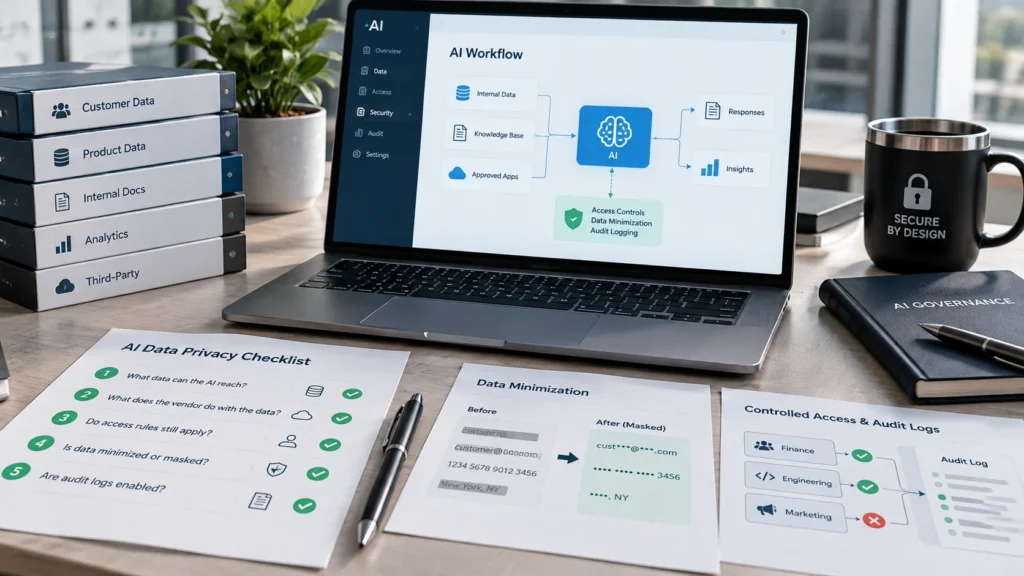
The short answer: before deploying any AI tool on company data, check five things. What data it can reach, what the vendor does with it, whether your access rules still apply, how much sensitive data you can remove, and how you will log what happens. These checks are part of every custom AI solution we design, and they take far less time before launch than after.
Why AI Changes the Privacy Question
Traditional systems keep data in known places: a database, a CRM, a file server, each with its own permissions. AI tools move data around in new ways. Content gets copied into prompts, turned into search indexes and saved in logs, sometimes with a third-party provider.
The bigger risk is often internal. An AI assistant connected to shared files can answer questions with information the person asking was never supposed to see. The data never left the company, but it still reached the wrong person.
Five AI Data Privacy Checks Before You Deploy
- What data can the AI reach? Make an inventory of every source the tool connects to, and flag personal, financial, health and HR data. If you can’t list it, you can’t protect it.
- What does the vendor do with your data? Read the terms for training use, retention periods, processing regions and subprocessors. Business and enterprise plans often differ from consumer versions, so check the plan you will actually use.
- Do your access rules still apply? The AI should respect the same permissions as the source systems. A sales rep who can’t open the payroll file shouldn’t get its contents through a chatbot.
- Can you send less? Pass only the fields a task needs, and mask or remove names, IDs and account numbers where the answer doesn’t depend on them.
- Will you know what happened? Log who asked what, which data was used and what the AI returned. Add human review before outputs reach customers or touch sensitive decisions.
A Practical Example: The Assistant That Knew Too Much
Consider a company that connects an AI assistant to its shared drive so employees can ask questions about policies and past projects. The pilot works well, until someone asks about compensation and the assistant summarizes a salary spreadsheet saved in a folder with loose permissions.
Nothing was hacked. The assistant did exactly what it was built to do. The fix is the checklist above: scope the sources, exclude sensitive folders, enforce the user’s existing permissions and log every query. It is also why narrow, well-defined use cases tend to succeed where broad ones stall, a pattern we cover in why AI pilots fail.
Where Regulation Fits
Privacy laws such as GDPR in Europe and state privacy laws in the US apply to personal data whether or not AI processes it, and some industries add their own rules. For a structured approach to AI risk, the NIST AI Risk Management Framework is a useful, voluntary reference.
None of this replaces your legal team. The goal of the technical checks is to give legal a clear picture of where data goes, so their review is fast and specific instead of a long list of unknowns.
The Bottom Line
AI data privacy is not a reason to avoid AI. It is a reason to design it carefully. Know what the AI can reach, keep your access rules intact, send less sensitive data and log what happens. Companies that do this can move faster with tools like conversational BI, because leadership trusts what is running.
Sisifo Analytics builds AI on company data with these controls designed in from day one, as part of our data strategy and custom AI work.
Planning an AI project that touches sensitive data? Book a 30-minute call with our team and we’ll review the risks with you before anything goes live.