
Many Databricks projects begin with a small team and a handful of notebooks. Code is promoted by hand, environments are configured by memory, and access is granted as needed. That works at first, then fails as the team and data volume grow — which is why Databricks CI/CD, infrastructure as code and governance belong in the first sprint.
The Problem With Manual Promotion
When code moves between environments by copy-and-paste, it becomes hard to know what is running in production, to reproduce an issue, or to roll back safely. A second or third engineer multiplies the risk.
1. Databricks CI/CD for Data Pipelines
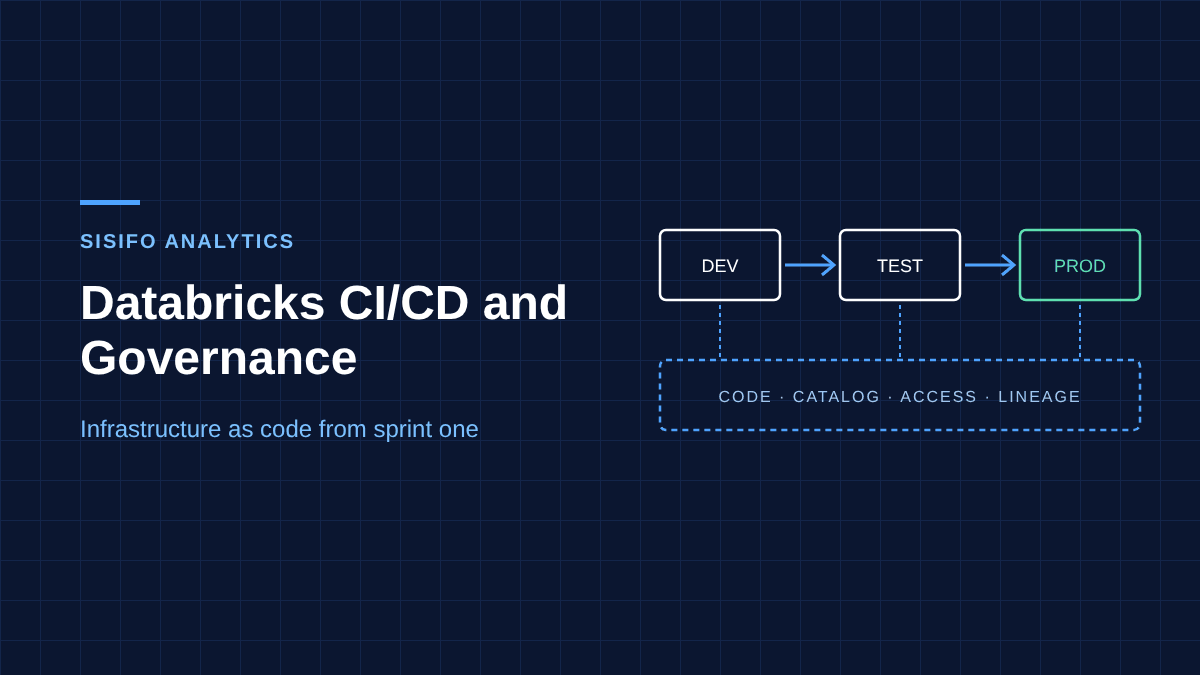
Store code in version control, run automated checks, and promote through development, test and production environments with a pipeline. Modern Databricks tooling, such as Databricks Asset Bundles, lets teams define jobs and pipelines as code and deploy them consistently — whether your pipelines follow an ETL or ELT pattern.
2. Infrastructure as Code
Define workspaces, clusters, permissions and storage in code, for example with Terraform. Environments become reproducible and auditable instead of tribal knowledge.
3. Governance From Day One
Use a central catalog, such as Unity Catalog, to manage ownership, access control and lineage. Setting this up early is far cheaper than retrofitting it onto a mature lake. A clear data governance framework makes these decisions easier.
4. Orchestration and Monitoring
Choose orchestration deliberately, monitor job health and data quality, and alert on failure so problems surface before business users find them.
A Practical Databricks CI/CD Starting Checklist
- Repository and branching strategy agreed before the first pipeline.
- Automated deployment to at least two environments.
- Environments defined as code.
- Catalog, ownership and access model documented.
- Alerts on job failures and data freshness.
Each item on this checklist is small on its own, but together they keep code, environments and access under control from the very first pipeline onward.
Taken together, these four practices turn a handful of notebooks into a platform that can be deployed, reproduced, audited and monitored as the team and data volume grow.
Frequently Asked Questions About Databricks CI/CD
Why does manual promotion stop working as a Databricks team grows?
When code moves between environments by copy-and-paste, it becomes hard to know what is running in production, to reproduce an issue or to roll back safely. Every additional engineer multiplies that risk.
What do Databricks Asset Bundles do?
They let teams define jobs and pipelines as code and deploy them consistently as they move through development, test and production environments.
Why define infrastructure as code?
When workspaces, clusters, permissions and storage are defined in code, for example with Terraform, environments become reproducible and auditable instead of depending on tribal knowledge.
When should a lakehouse team set up governance?
From day one. A central catalog such as Unity Catalog manages ownership, access control and lineage, and setting it up early is far cheaper than retrofitting it onto a mature lake.
What should monitoring cover?
Job health and data quality, with alerts on job failures and data freshness, so problems surface before business users find them.
Where should a team start with Databricks CI/CD?
Agree on a repository and branching strategy before the first pipeline, automate deployment to at least two environments, define environments as code, document the catalog, ownership and access model, and set alerts on failures and freshness.
How Sisifo Helps
Sisifo’s data and AI team builds data warehouses, pipelines, dashboards and AI agents, and brings these engineering practices into the build so the platform scales with your team. Learn more at Sisifo.