Most companies frame the in-house data team vs outsourcing question as a cost comparison: salaries on one side, a consulting invoice on the other. That comparison misses the point. The real question is what kind of data work you need over the next two years, and whether it is a build or a habit.
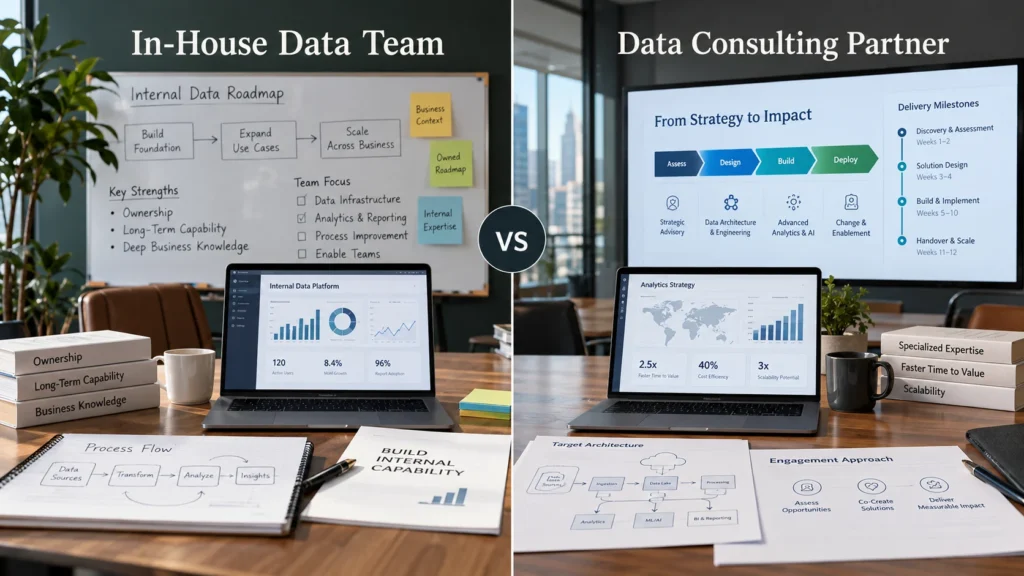
The short answer: hire in-house for work that never stops, like daily reporting, business questions and owning the numbers. Bring in a partner for work that has a beginning and an end, like building the platform, migrating systems or launching a first model. Most companies we talk to need both, in a specific order, and that order is usually the first decision in a data strategy engagement.
What an In-House Data Team Actually Requires
A working data function is not one person. It usually needs four kinds of skill: a data engineer to build and maintain pipelines, an analytics or BI developer to model data and build reports, a data scientist when forecasting or machine learning is on the table, and someone who owns definitions and data quality.
Few mid-sized companies can hire all four at once, so the first hire ends up covering everything. That creates two risks. The work moves at the speed of one person, and everything that person knows leaves with them if they do.
When an In-House Data Team Makes Sense
- The work is continuous. Weekly reporting, ad hoc questions from leadership and ongoing data quality work need someone inside the business every day.
- Context matters more than technique. Knowing why a customer is coded twice or why a region reports late is knowledge that builds over years.
- You already have a working platform. Maintaining and extending a solid foundation is a natural job for an internal team.
When a Data Consulting Partner Makes Sense
- The work is a project. Building a warehouse, migrating from spreadsheets or an old database, or setting up pipelines has a clear end, and it is the core of most data engineering engagements.
- You need several skills at once. A partner brings engineering, BI and data science together for the months you need them, without four permanent hires.
- Speed matters. Hiring a senior data engineer can take months. A partner can start with a defined scope in weeks.
The trade-off is real. A partner does not live inside your business, so without a plan for handover, you trade a hiring risk for a dependency risk.
The Hybrid Model Most Mid-Sized Companies End Up With
Consider a company with 300 employees, one analyst and reporting that still runs on spreadsheets. Hiring a full team would take a year. Leaving the analyst alone means the platform never gets built.
The common path is a split. A partner builds the pipelines, the warehouse and the first set of trusted reports. The analyst works alongside from day one, owns the reports once they go live and becomes the person who knows how everything fits. A year later, the company hires its first data engineer to maintain what was built, and the partner steps back to specific projects.
The key is that knowledge transfer is part of the scope, not an afterthought. It is the same principle behind starting small with AI: build something that works, prove it, then scale with your own people.
Questions to Ask Before You Decide
- Is this work a project or a permanent function? Projects favor a partner. Permanent functions favor a hire.
- Who will own the numbers after launch? If the answer is nobody, start there before choosing anyone.
- How many different skills does the next year require? One skill can be hired. Four usually cannot, at least not at once.
- What happens if a key person leaves? Documentation, shared ownership and clear handover reduce the risk on either path.
The Bottom Line
The in-house data team vs outsourcing decision is not either-or. Hire for the work that never ends, partner for the work that has a finish line, and plan the handover from the start. Companies that sequence it this way get a working platform faster and still end up owning their data.
Sisifo Analytics works as that partner for mid-sized companies, from data strategy to the pipelines and reports your team will own afterward.
Weighing your next data hire against outside help? Book a 30-minute call with our team and we’ll help you map what to build and what to own.