
Distribution businesses run on thinner margins and thinner visibility than almost any other segment of the economy. A typical mid-market distributor manages thousands of SKUs, dozens of supplier relationships, and a sales force covering hundreds of accounts — and still makes most of its commercial decisions from static spreadsheets, monthly reports, or gut instinct. That gap between how much data a distributor generates and how little of it gets used in real time is exactly where AI-powered analytics creates the most value.
The Real Problem Isn’t a Lack of Data
Ask most distributor executives whether they have enough data, and the answer is almost always yes. Sales history, inventory levels, purchase orders, customer records — it all exists somewhere, usually spread across an ERP system, a CRM, supplier portals, and a patchwork of spreadsheets built by whoever needed an answer fastest. The problem isn’t data scarcity. It’s fragmentation, latency, and the fact that turning raw data into a decision still requires someone with the time and the technical skill to go find it, clean it, and interpret it.
That’s the layer where a data agent — an AI system trained specifically on a distributor’s own commercial, inventory, and financial data — changes the equation. Instead of waiting on a report, a sales leader, an operations manager, or a CFO can ask a direct question in plain language and get an answer grounded in their actual numbers, in seconds rather than days.
Four Places AI Analytics Pays for Itself in Distribution
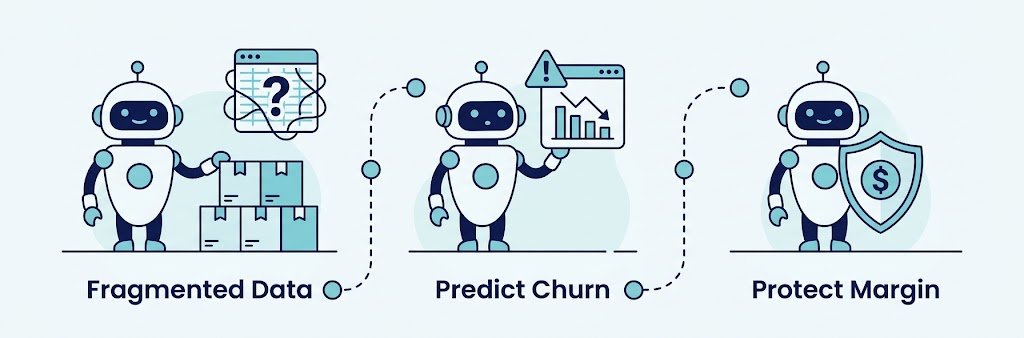
Churn prediction. Distributors often don’t notice an account is at risk until the order volume has already dropped for two or three consecutive months. Predictive models trained on ordering cadence, product mix shifts, and payment behavior can flag early warning signs while there’s still time for a sales rep to intervene.
Upsell and cross-sell identification. Most distributors carry far more SKUs than any single sales rep can mentally cross-reference against a customer’s buying history. Pattern-matching across the full catalog surfaces adjacent products a given account is statistically likely to buy — turning account reviews from guesswork into a data-backed conversation.
Margin protection. Margin leakage rarely shows up as one dramatic event. It accumulates from small pricing exceptions, rebate miscalculations, and freight cost creep that nobody catches until the quarterly numbers come in soft. Real-time margin tracking at the transaction level catches the leak while it’s still small.
Working capital and bad-debt risk. Finance teams are often the last to see a credit risk forming, because the signal is buried in payment timing and order pattern shifts that live outside their usual reports. Surfacing that risk earlier gives finance a genuine seat at the commercial table instead of a purely reactive one.
Why Guardrails Matter More Than Model Sophistication
Any conversational analytics tool built on top of company data has to solve one problem before anything else: it has to refuse to guess. A chatbot that answers a sales question with a plausible-sounding but incorrect number is more dangerous than a spreadsheet that gives no answer at all, because the wrong answer gets acted on. The systems worth trusting are built with explicit guardrails — grounding every answer in the underlying transactional data, flagging when a query can’t be answered reliably, and giving users a way to verify the source behind any number before they act on it.
Integration Is the Unsexy Part That Determines Success
The most sophisticated analytics layer is only as good as the data feeding it. For most distributors, that means connecting to an existing ERP and CRM, reconciling sell-in data from internal systems with sell-out data from distributor or retail partners, and deciding how fresh the data needs to be — a same-day refresh is achievable and inexpensive; true real-time sync is technically possible but rarely worth the added cost for a sales or inventory use case. Getting this integration layer right, quietly, in the background, is what makes the front-end experience feel simple.
Where This Is Heading
The distributors who adopt conversational, AI-driven analytics now aren’t just solving a reporting problem — they’re building an operating advantage that’s hard for a spreadsheet-based competitor to catch up to later. As more of the category adopts this kind of tooling, the bar for “good enough” visibility keeps rising, and the businesses that waited will be doing so from behind.