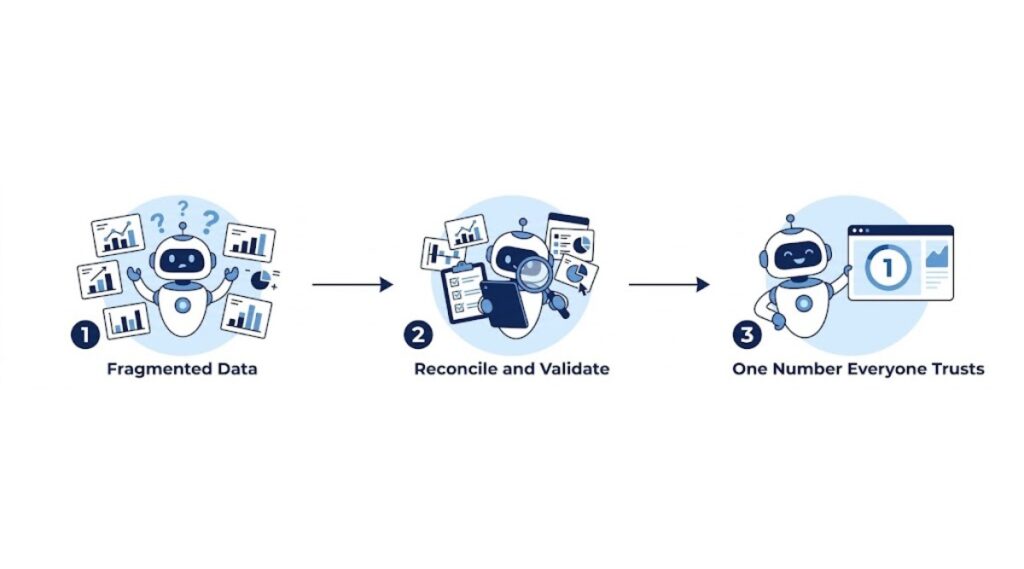
A single source of truth is what separates a commercial organization that argues about the numbers from one that acts on them. Most teams don’t get there by ripping out every system at once — they get there with a deliberate, staged roadmap. Here’s what that roadmap looks like in practice.
Why “Data Chaos” Is a Growth Blocker
Ask five people at a mid-sized company what last month’s revenue was, and you may get five different answers. Sales pulls a number from the CRM. Finance pulls one from the ERP. Commercial teams have their own spreadsheet, patched together from distributor reports and gut-checked against memory. None of these numbers are wrong, exactly — they’re just built on different definitions, different timing, and different assumptions.
This is one of the most common and most expensive problems we see in commercial data analytics: not a lack of data, but a lack of agreement about which data is true. The result is slow decisions, duplicated reporting work, and executives who quietly stop trusting dashboards. Solving that gap in trust is precisely the job of a single source of truth.
Start With the 80%, Not the 100%
The instinct when facing fragmented data is to plan a full platform migration — one modern data warehouse, one reporting layer, everything unified at once. That instinct is usually right in the long run and wrong as a starting point. Full migrations take months, and the business can’t wait months for its first trustworthy report.
A better sequence: identify which one or two data sources already cover the majority of the picture — often 70 to 80 percent of volume or revenue — and reconcile those first in a lightweight sandbox environment. Get a working, validated view of the core of the business before spending time on the long tail of manual, low-volume sources. Quick wins build organizational trust in the process, which makes the eventual full migration easier to fund and easier to adopt.
Standardize Your Taxonomy Before You Standardize Your Reports
Almost every data fragmentation problem has a taxonomy problem underneath it. The same customer might be coded differently in three systems. Product categories drift over time as new SKUs get added without a consistent classification rule. Channels and routes are labeled inconsistently across regions or business units.
Until these are standardized, no dashboard can be fully trusted, because different reports are silently applying different definitions of “customer,” “channel,” or “category.” Investing in a shared taxonomy and a governance process for maintaining it — so that new products and customers get classified consistently as they’re added — pays for itself many times over in reduced reconciliation work. Skipping this step is why so many single source of truth initiatives stall: the dashboards get rebuilt, but the underlying disagreement about definitions never actually gets resolved.
Validate Against Ground Truth Before You Scale
Before any new dashboard or data model goes in front of executives, it should be reconciled against a closed period that finance or commercial teams have already reported through their existing process. This sounds obvious, but it’s frequently skipped in the rush to show visual progress. A beautiful dashboard built on an unvalidated data model just creates a new, better-looking version of the trust problem it was meant to solve. In other words, a data model only earns the label single source of truth once it has been checked against numbers the business already trusts.
Let AI Accelerate the Last Mile, Not the First Step
Generative AI tools are now genuinely useful for turning a validated data model into a working dashboard prototype in hours rather than weeks — ingesting the underlying data structure and business logic, and producing a first-pass interactive view for stakeholders to react to. This is a real acceleration, but it only works once the underlying measures are correct. Using AI to skip the reconciliation and taxonomy work — asking it to “make sense of” messy, unvalidated data — tends to produce fast, confident-looking answers that are wrong in ways that are hard to detect later.
The right order of operations is: reconcile the core data, standardize the taxonomy, validate against ground truth, and only then use AI to accelerate visualization and iteration.
From Single Source of Truth to Proactive Analytics
Once commercial teams trust one number, that same validated data foundation can support far more than reporting. As Profisee’s guide to building a single source of truth notes, most of the effort involved is organizational — governance, ownership, and shared definitions — rather than purely technical, which is exactly why the roadmap above starts with reconciliation and taxonomy rather than tooling.
That foundation is also what makes AI genuinely useful in commercial analytics, instead of a new source of noise. Distributors that have reconciled their core numbers can layer on AI agents that watch the data continuously, flagging churn risk or margin erosion the moment it appears instead of waiting for the next reporting cycle.
The same validated model also powers AI data agents that let commercial teams ask questions in plain language and get answers pulled from the single source of truth, rather than from whichever spreadsheet happens to be open. None of that is possible, though, until the underlying data actually agrees with itself — which is the whole point of the roadmap above.
The Payoff: A Single Source of Truth Everyone Trusts
Companies that follow this sequence end up with something more valuable than a dashboard — they end up with an organizational habit of trusting a single number. Meetings stop opening with “whose numbers are we using” and start with “what should we do about this.” That shift, more than any specific tool or platform, is what a single source of truth is really worth.