
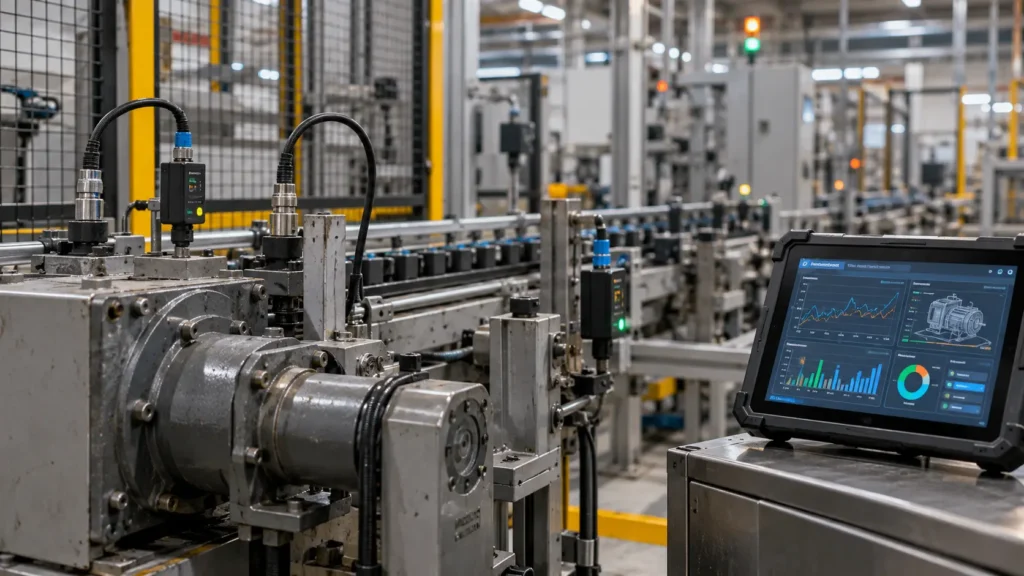
Most predictive maintenance projects in manufacturing start in the wrong place: with the model. Teams pick an algorithm, connect every sensor they have and wait for predictions. Months later, there are dashboards full of alerts and very few avoided breakdowns.
The short answer: start with one critical asset whose failures cost the most, confirm you have its sensor readings and maintenance history, and begin with simple condition alerts before building a prediction model. Then connect every alert to a work order, so someone acts on it. That narrow start is how we scope custom AI solutions for plants.
Preventive, Condition-Based and Predictive Maintenance
| How it works | Trade-off | |
|---|---|---|
| Preventive | Service on a fixed schedule, by date or hours of use | Simple, but parts get replaced too early or fail between visits |
| Condition-based | Act when a reading crosses a set limit, such as temperature or vibration | Catches clear problems, misses slow patterns |
| Predictive | A model estimates when failure is likely, based on history and current readings | Most precise, but needs good data and failure examples |
Most plants that succeed move through these in order. Condition-based alerts deliver value early and generate the clean history a predictive model needs later.
What You Need Before You Start
- Sensor data from the asset. Vibration, temperature, pressure or motor current, recorded often enough to show change over time.
- Maintenance history. Work orders with dates, what failed and what was done. This is where most plants have gaps, because failures are logged inconsistently or in free text.
- Production context. Shifts, speeds and products running at the time. A machine that runs hot on one product isn’t necessarily failing.
- A place to keep it. High-frequency sensor data outgrows spreadsheets fast. The right storage depends on volume, as we explain in data warehouse vs data lake vs lakehouse.
Predictive Maintenance in Manufacturing: A Step-by-Step Start
- Pick one asset. Choose the machine where an unplanned stop costs the most in downtime, scrap or late orders.
- Define the failure. Agree on what counts as a failure and how far ahead a warning is useful: hours, days or weeks.
- Clean the history. Line up sensor readings with past failures and maintenance events.
- Start with alerts. Set condition thresholds and anomaly alerts first, and check them with the maintenance team.
- Build the model. Once enough failure events are recorded, train a model to estimate risk, the kind of work our data science team does.
- Close the loop. Send every alert to the maintenance system as a work order, and track avoided stops.
A Practical Example: The Packaging Line Motor
Consider a plant where a motor on the main packaging line stops a few times a year, each time halting the line for a full shift. The motor has vibration and temperature sensors, but the readings are only stored for a week, and repairs are logged in a shared spreadsheet.
The first step isn’t a model. It is keeping the sensor history and logging each repair consistently. Within weeks, anomaly alerts on vibration can flag unusual behavior. After several months of clean history, there is enough data to estimate failure risk, and the plant decides whether to extend the approach to other lines.
Common Mistakes to Avoid
- Starting plant-wide. Connecting every machine at once spreads effort thin and delays the first result.
- Expecting predictions without failures. Models learn from past failures. If an asset rarely fails, anomaly detection is the better tool.
- Alerts nobody owns. An alert that doesn’t create a task gets ignored after the first false alarm.
The Bottom Line
Predictive maintenance in manufacturing pays off when it starts small and practical. One asset, one clear definition of failure, alerts first and a model when the data supports it. It also fits naturally into a broader shift toward AI business intelligence for manufacturing, where plant data drives decisions instead of monthly reports.
Sisifo Analytics builds predictive maintenance pilots on real plant data, from sensor pipelines to the models and alerts, as part of our custom AI work.
Have a machine that keeps stopping your line? Book a 30-minute call with our team and we’ll help you scope a first pilot.